
16,000 Year Old Columbian Mammoth Discovery & Recovery
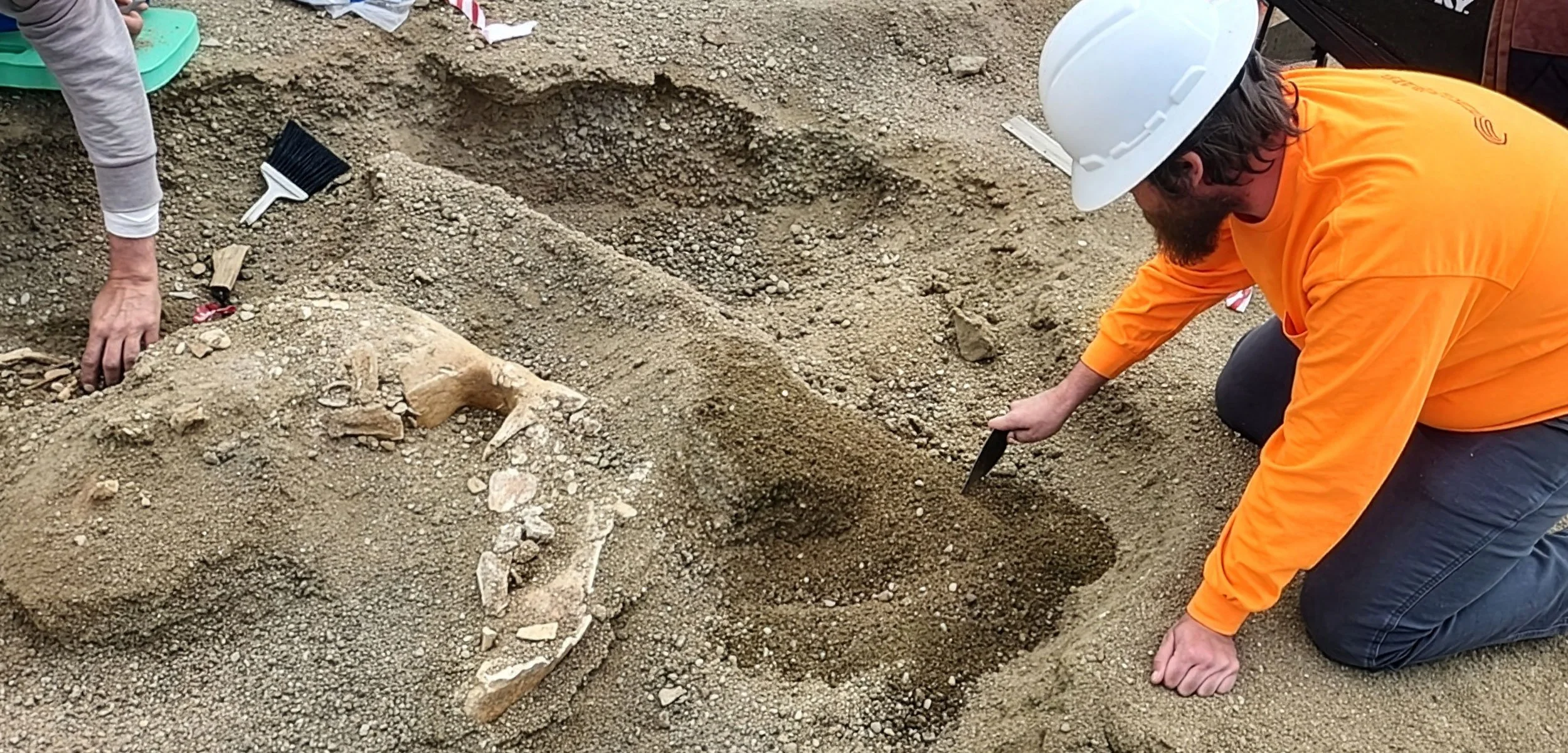
At first, this call did not seem entirely out of the ordinary…
On March 17, 2023, I received a call regarding some potentially sensitive material identified during excavation at a construction project in Rosamond, California. Months prior to this, BCR Consulting had been contracted to handle cultural and paleontological resources for the project in the event that anything was uncovered during development. At first, this call did not seem entirely out of the ordinary. Woody, the operator of a grader (a piece of heavy equipment used to strip away dirt to lower the elevation an area), saw something unusual as he worked. A light-colored solid mass appeared out of the otherwise homogeneous brown sediment at a depth of about five feet, along with a few other smaller pieces of what appeared to be the same material. Many people might have thought nothing of it, but Woody had found something similar to this before. Last time he saw something like that, it turned out to be a fossil! So, he stopped working and notified the proper project personnel as he took a closer look at the material for himself. They roped off an area surrounding the material in which no further work was to take place until it could be examined by an archaeologist.
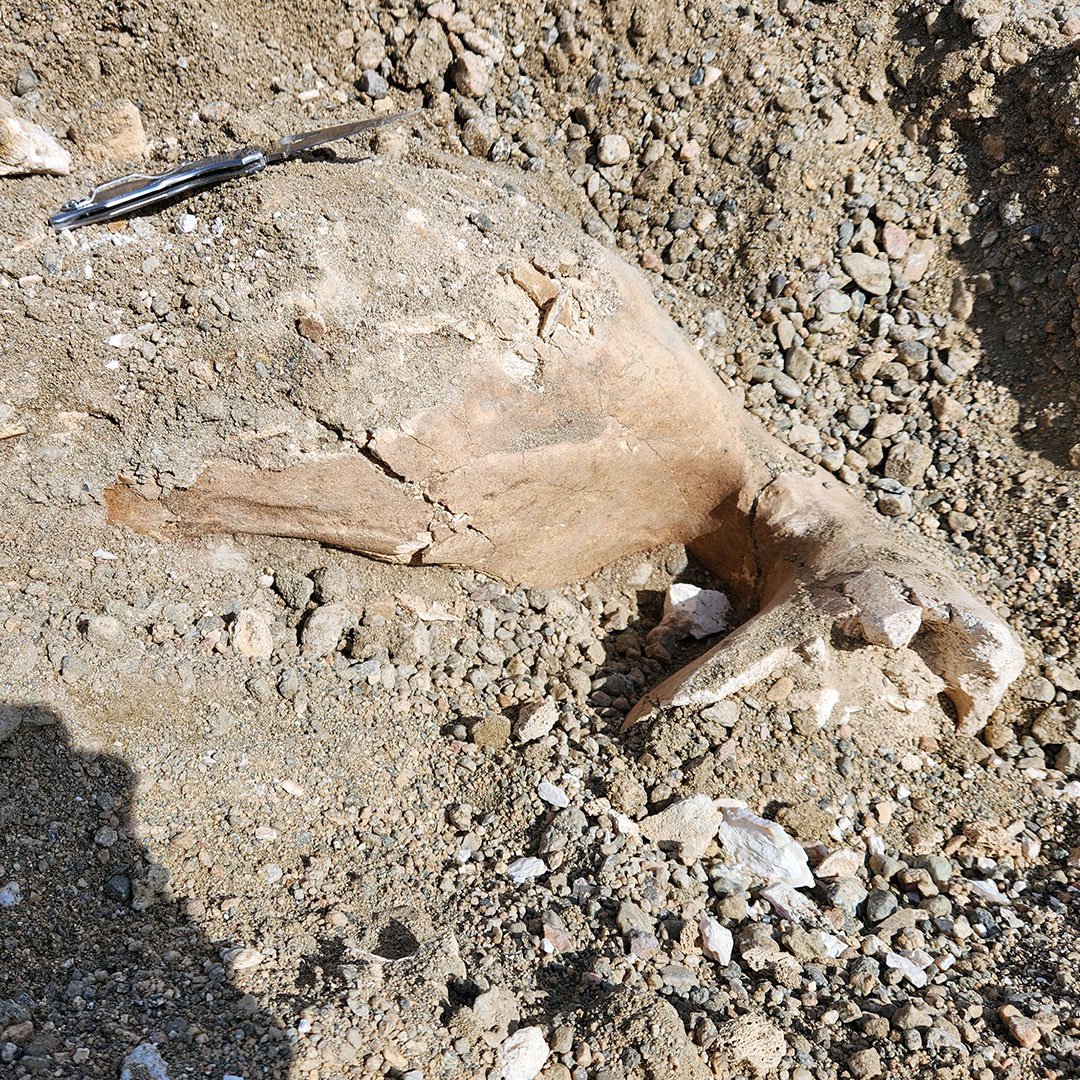
It looked like a bone alright!
By the time I received the call, the project personnel that had contacted BCR were thinking that it could be a fossil, or maybe it could be more recent bone. It was now my job to drive from Barstow, where I had just finished another small project, to the Rosamond site so I could assess what the material in question was and whether anything further needed to be done.
When I arrived on site, I was escorted to the location of the material. I had been assuming that it would be a cow bone or something similar and I would be able to quickly dismiss the find as being simply a recent and/or non-archaeological (not having been modified by humans) animal bone. When I saw it, my first thought was that it was unusual. It was indeed bone, and a large one at that. Several freshly broken pieces were strewn about the area, some of them measuring almost a foot in maximum diameter. A largely intact bone was poking out of the ground near the center of the scatter (see above photo). I used a small shovel to gently clear away some of the dirt surrounding the element. As the sediment was peeled away, it quickly became apparent that this was larger than any cow bone could be. It was at least a foot-and-a-half long and I knew that much of its size could still be concealed by the dirt. I had never seen anything quite like it. The bone did not appear to be fossilized, which would generally suggest a relatively recent age. At this point, I called Principal Archaeologist David Brunzell to discuss what I had seen. He said that such a large bone found so deep (approximately five feet below the surface) had to be the remains of a prehistoric animal. “But why doesn’t it look fossilized then?” I asked. We are archaeologists, so we specialize in studying material left behind by humans in the past. This was outside of our wheelhouse. So we made a call…
BCR Consulting had contracted San Diego Natural History Museum (SDNHM) to handle paleontological monitoring for this project. At this point they were not on site, but were ready for a situation like this. Museum staff asked me to send pictures of the material to them. Although it appeared unfossilized and therefore probably modern, they decided they should make a trip to the site themselves. Once on site, SDNHM’s paleontologist quickly determined that the bone was either a Mammoth or a Mastodon! Remarkably, the bones were indeed virtually unfossilized. This meant that the particular environment and sediment that the material was deposited in had characteristics necessary for very good preservation and for very slow mineralization. But there was more. The paleontologist noticed some interesting marks on the material. It wasn’t clear enough to know for sure, but they thought these marks could be left from the intentional butchering of the animal by humans!
Consultation between BCR Consulting, SDNHM, and the client took place following this. It was decided that the bones would be removed by the Museum through paleontological excavation. BCR Consulting was invited to provide archaeologists for the excavation based on the marks which were potentially left by humans.
The team was composed of SDNHM staff Patrick Sena, Jesse Shelmire, and Gino Calvano, along with BCR Consulting staff Timothy Blood, Doug Kazmier, and myself. The beginning of the excavation was planned out as an essentially archaeological project, which usually entails slower and more detail-oriented progress in order to gather fine-grained data concerning human activity and changes in age. A grid of one-by-one-meter squares was laid out over the entire area. Three of these square units were selected for archaeological excavation. As we slowly peeled away layer after layer of sediment, only fossils were uncovered. There were no signs of human presence. The marks which had initially been identified as possibly human in origin were also studied more closely. It was determined that they were not created by humans after all, but rather by natural processes. Therefore, once the excavation units had been brought down 30 centimeters each with zero evidence of humans having been there, it was concluded that we were dealing with Proboscidea fossils only (this is the order that both mammoths and mastodons are a part of).
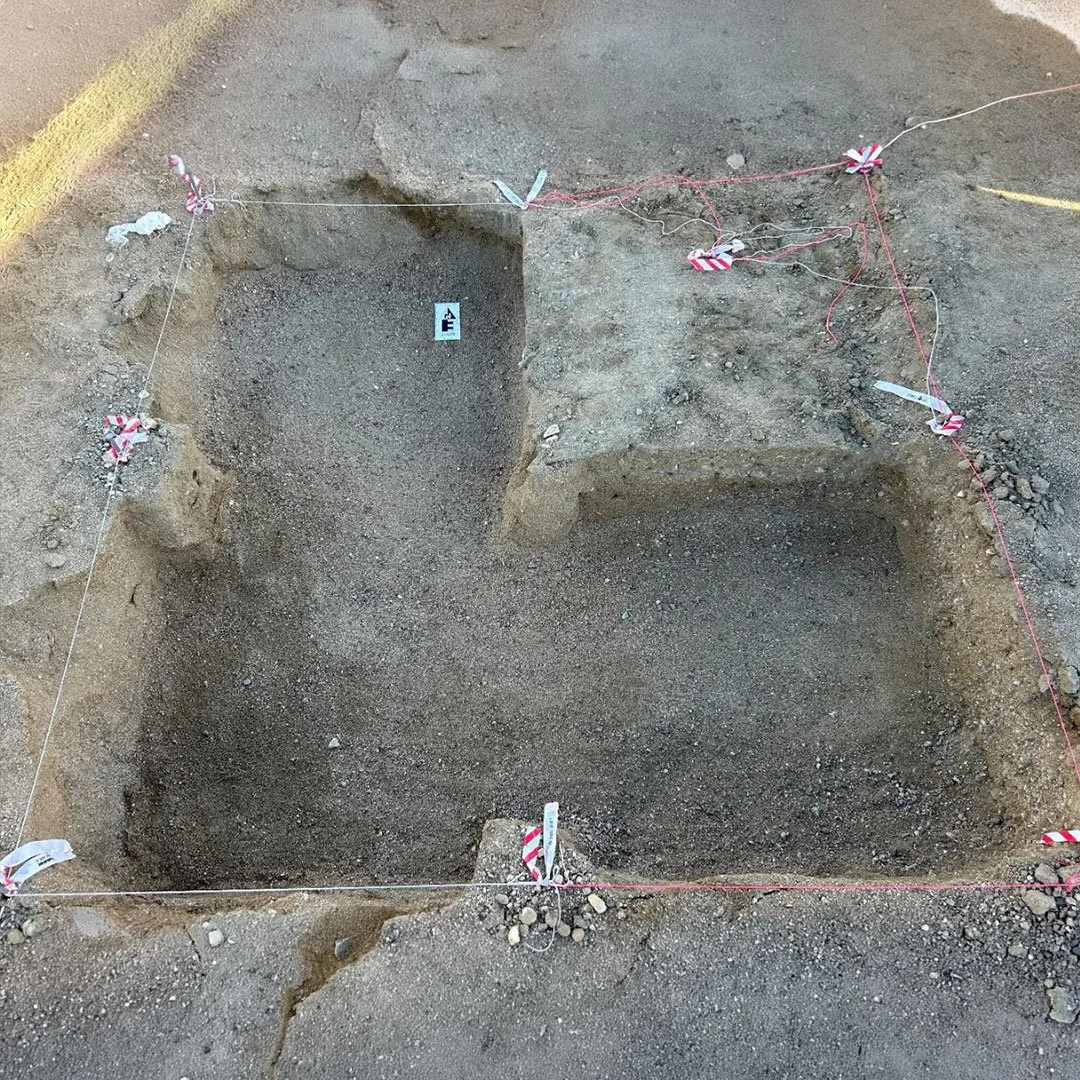
The three archaeological excavation units.
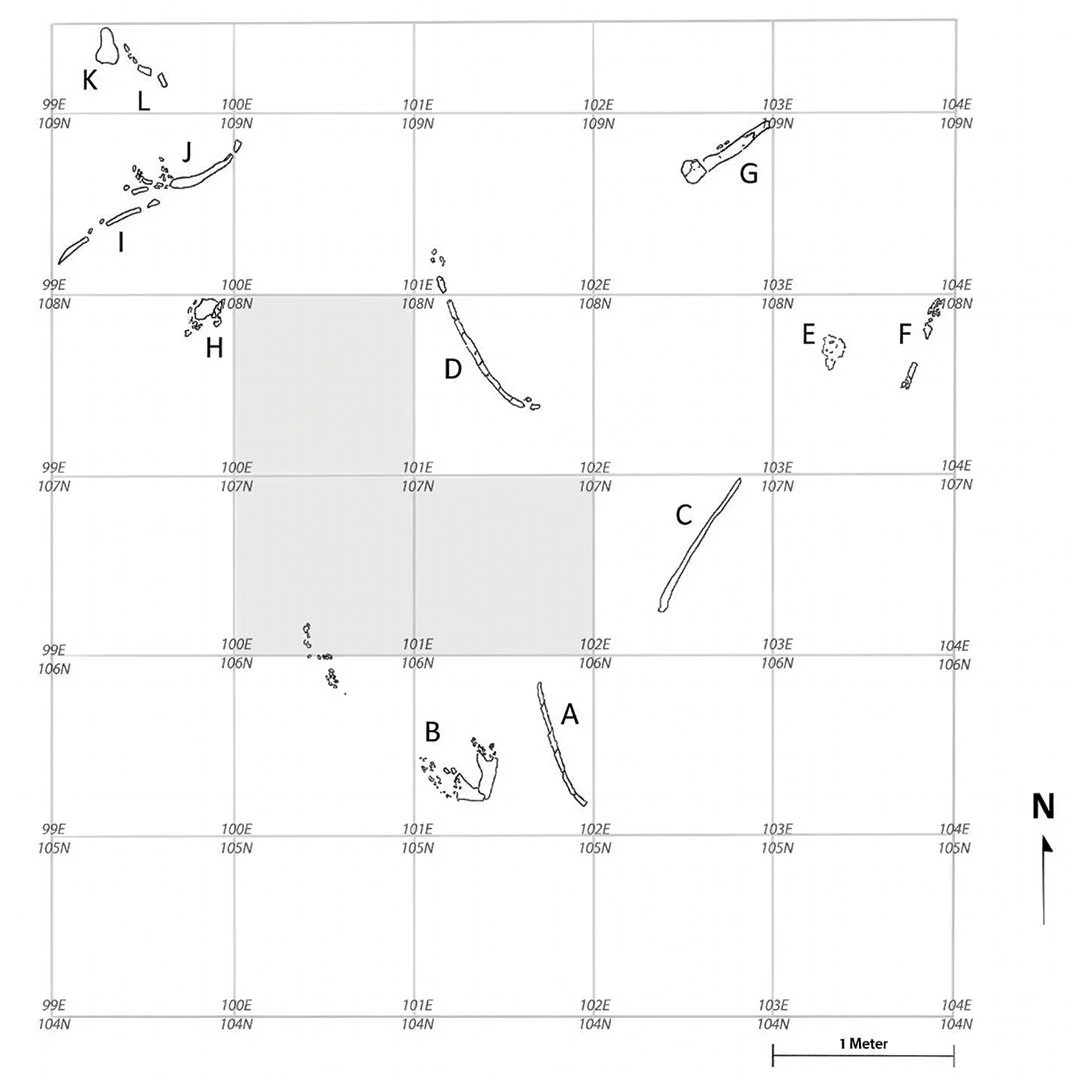
Illustration of the grid that was set up over the entire area
The archaeological excavation units are shown in gray, and the bones are sketched as well. A- nearly complete rib; B-nearly complete mandible with both lower third molars; C- complete rib; D- complete rib; E- cluster of bone fragments; F- fragmentary rib; G- partial rib; H- cluster of bone fragments; I- partial rib; J- nearly complete rib; K- partial cervical vertebra; L; fragmentary vertebra. Taken from Mueller et al. (2024).
Slowly but surely, more and more bones emerged and took shape around the site.
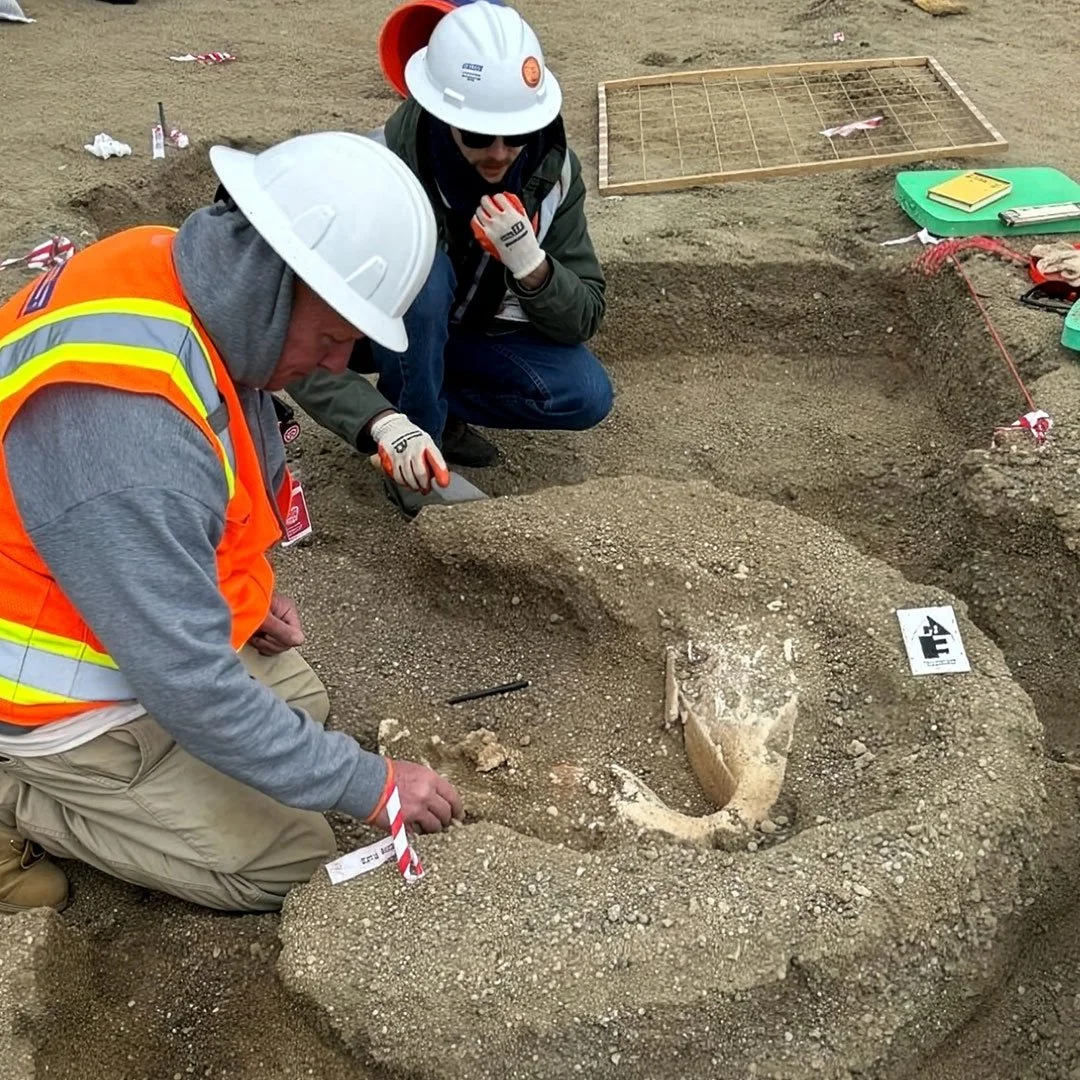
Patrick Sena (left) and Nick Shepetuk (right) excavating the sediment around the mammoth mandible.
From there on out the excavation was shifted to a purely paleontological approach. In this case, that meant that digging could be done more rapidly because we were only looking for large, easily identifiable fossils, rather than the vast array of cultural material and other subtle archaeological indicators that could be encountered during an archaeological project. Slowly but surely, more and more bones emerged and took shape around the site. The bone that was first found by Woody had been confirmed as a nearly complete mandible (later SDNHM found that both lower third molars were present in it). Five ribs were exposed, although several of them were not complete. And two vertebrae were also identified.
Each bone was pedestalled (an excavation technique that involves removing dirt from around but not from underneath an object so that it is left standing on a pedestal of sediment) and soaked in butvar (a polyvinyl resin), along with the dirt immediately surrounding them, to protect and consolidate them. Once this had been done to all the elements, it was time to plaster cast them. We mixed plaster of paris and dipped strips of burlap in it before applying the wet strips directly to bones. Once the first layer of plaster had dried, we applied another, and another, until the bones had been sufficiently protected for their removal and transportation. We carefully moved the plaster-jacketed bones into SDNHM’s vehicle.
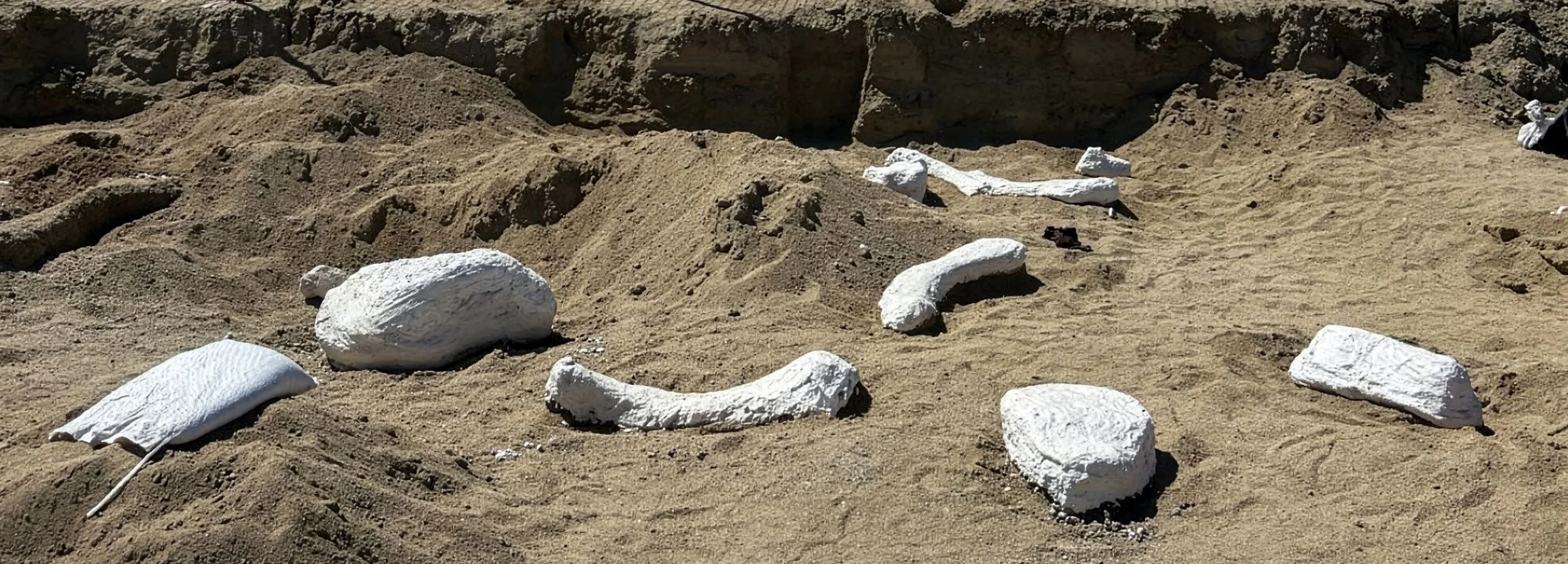
Several bones in completed plaster jackets awaiting removal.
With all the bones loaded up and ready to go, they were transported over 200 miles back to the SDNHM, where they were slowly removed from their casts. First, the cap was taken off with a cast cutting saw to reveal the bottom of the collection of dirt which was still held in place, not having been disturbed thanks to the butvar that it was soaked in (Mueller et al. 2024). Tools which are well-suited to delicate work, such as air scribes, X-Acto knives, dental picks, small brushes, and pin vises, were used to chip away at the consolidated dirt and reveal the fragile bones. Special cradles constructed from plaster were made to protect the bones for permanent storage.
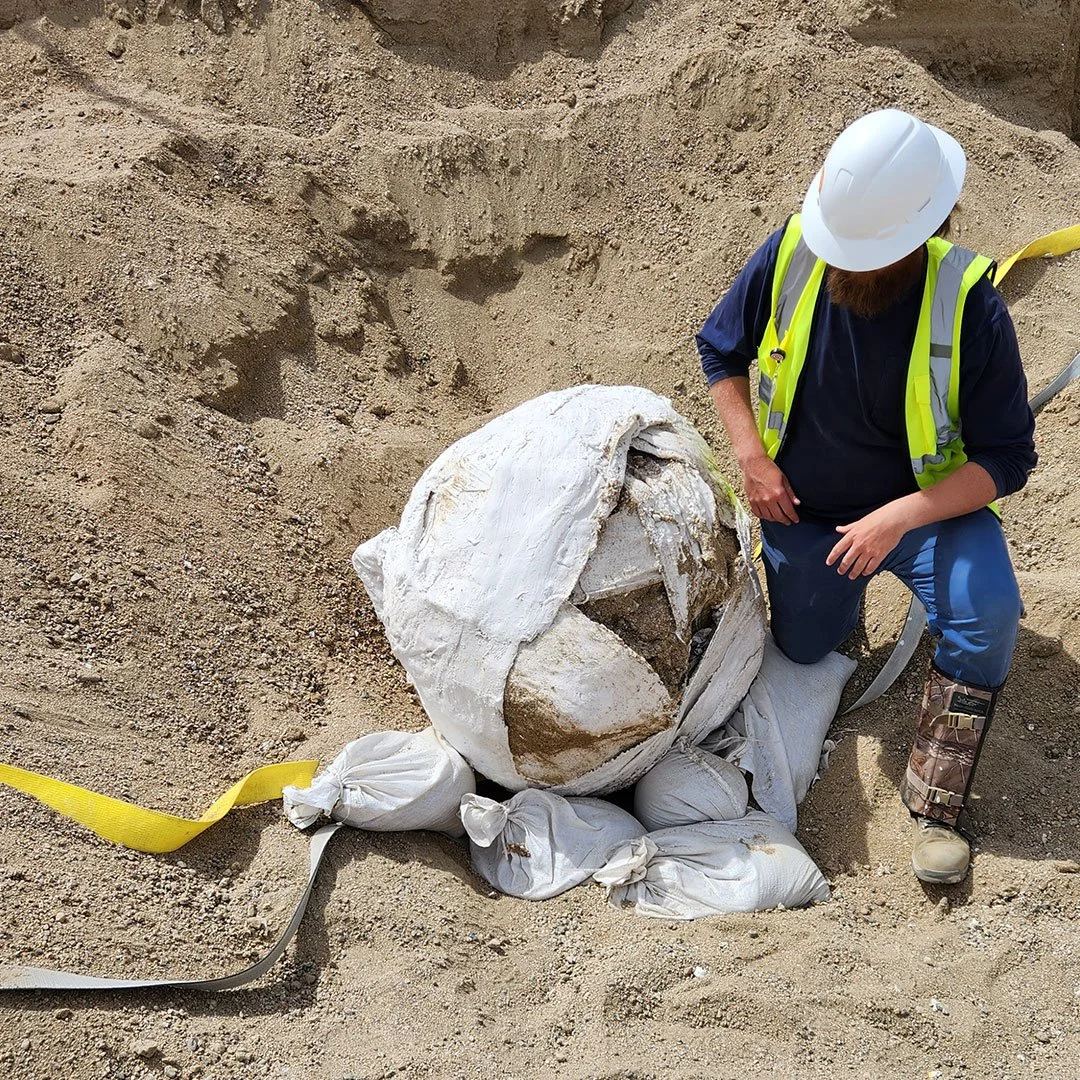
The largest and most delicate specimen was the mandible.
It required a small excavator (a piece of heavy equipment with a crane) to lift it into the truck. Here you can see BCR Consulting Archaeological Crew Chief Doug Kazmier proudly examining the plaster jacketed mandible as it awaits final jacket preparation and removal.
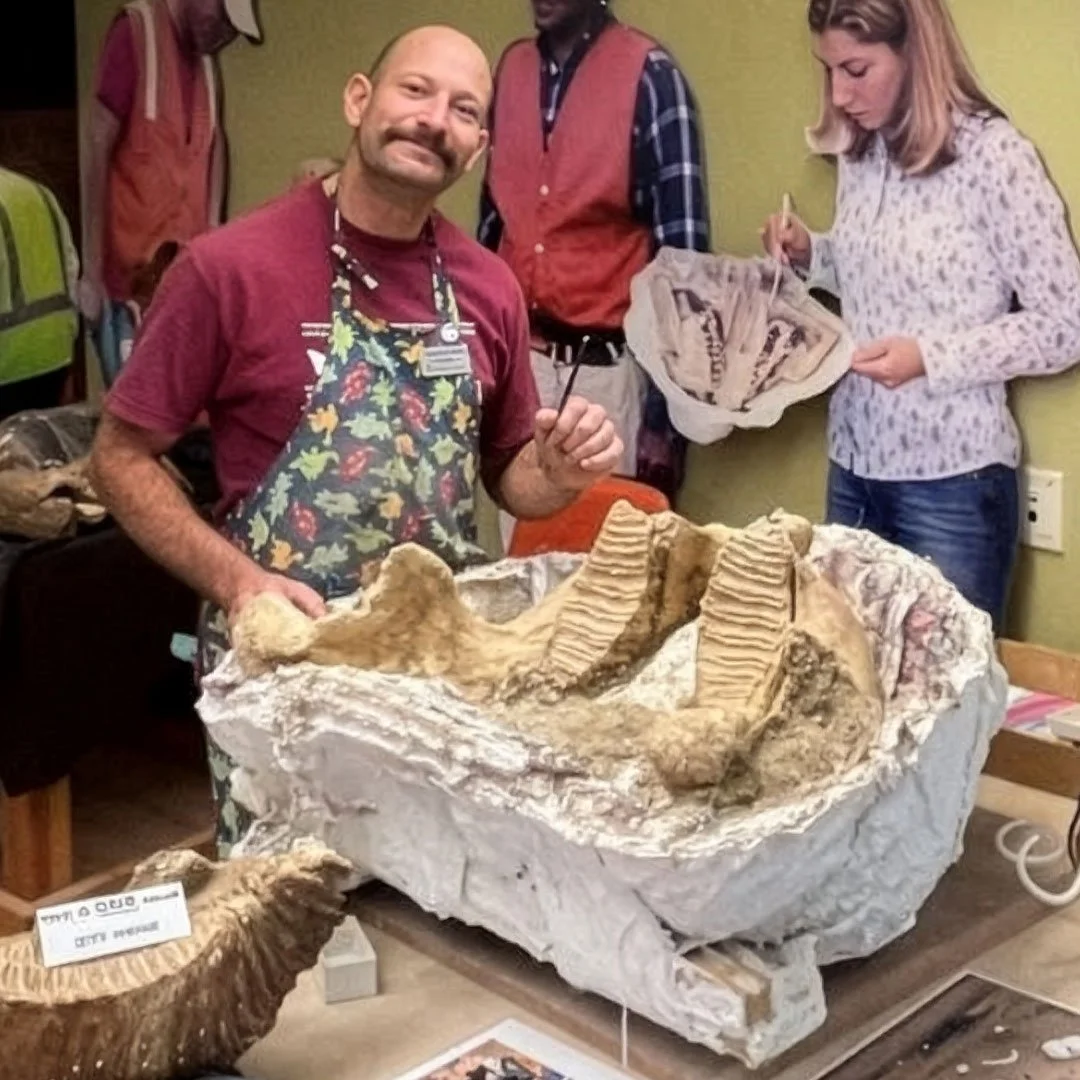
Lead Fossil Preparator Chris Plouffe posing with the mandible in its plaster jacket in the Hazard Family Demonstration Lab in the SDNHM.
While studying the mandible, SDNHM staff were able to determine that it was from a Columbian Mammoth (Mammuthus columbi) who was between 47 and 49 years old. It is known that during the late Pleistocene epoch (the last time mammoths were common in North America), a large lake referred to as Lake Thompson occupied the a significant portion of the westernmost Mojave Desert. Through careful study of the mammoth remains and the local geology, SDNHM staff determined that it likely died within the lake or close to its shore. The bones were transported by wind and flowing water to the shore area where they were buried and later discovered by Woody.
Age estimation of the mammoth bones was based on a previously estimated age range of the layers of dirt in which they were found (Orme 2008). SDNHM staff concluded that these layers were deposited from about 16.2 to 12.6 ka (thousand years ago) when Lake Thompson was shrinking.
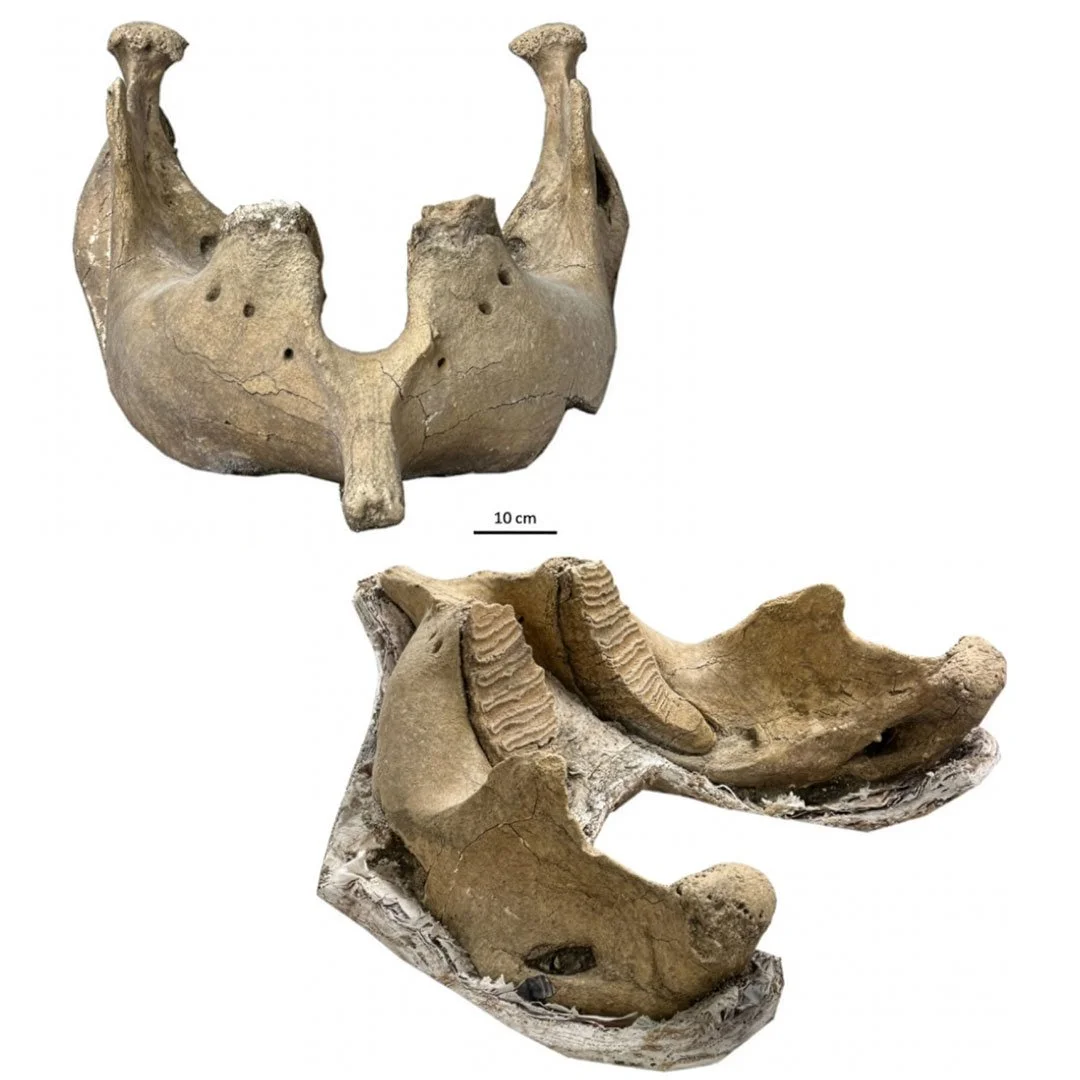
The Columbian mammoth mandible after having been fully prepared and preserved by SDNHM staff. Taken from Mueller et al. (2024).
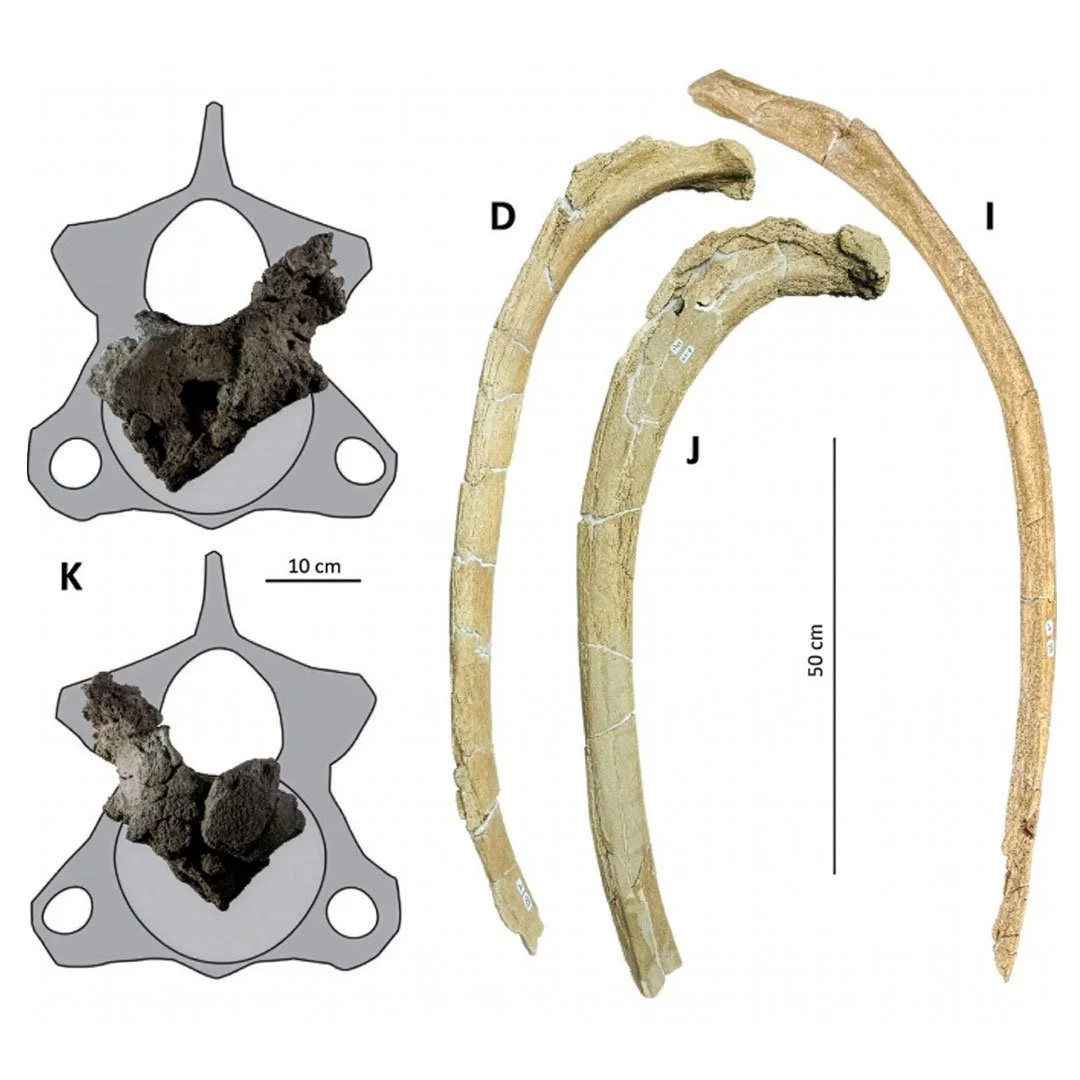
Three of the ribs and the two partial vertebrae after having been fully prepared and preserved by SDNHM staff. Taken from Mueller et al. (2024).
References
Mueller, Kristin L., Katie M. McComas, and Thomas A. Demere
2024 Paleontological Mitigation Report: Raceway Solar, Kern County, California. San Diego Natural History Museum. Report on file with BCR Consulting, Claremont, California.